Embassy

Autonomy Staged in Public
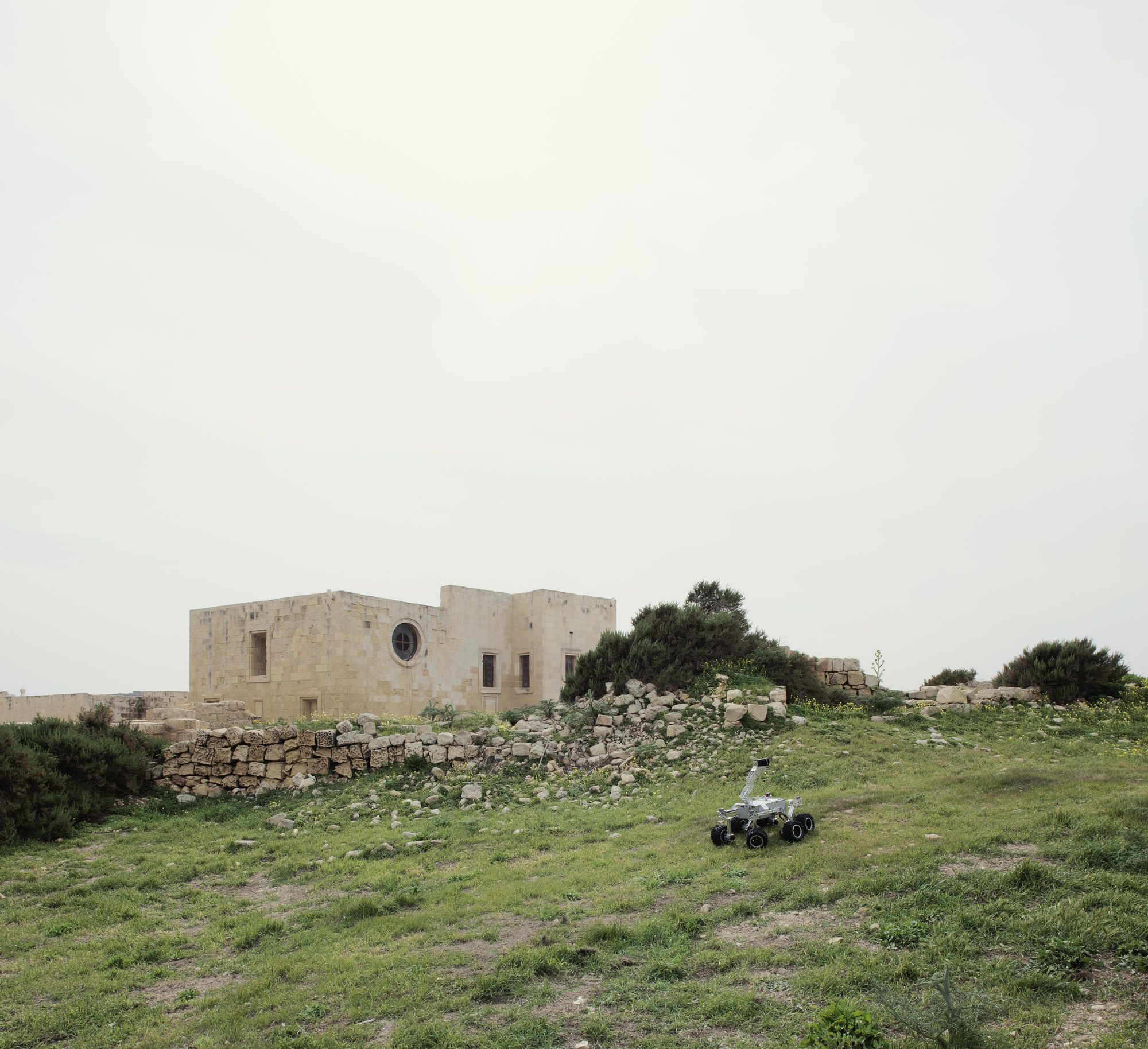
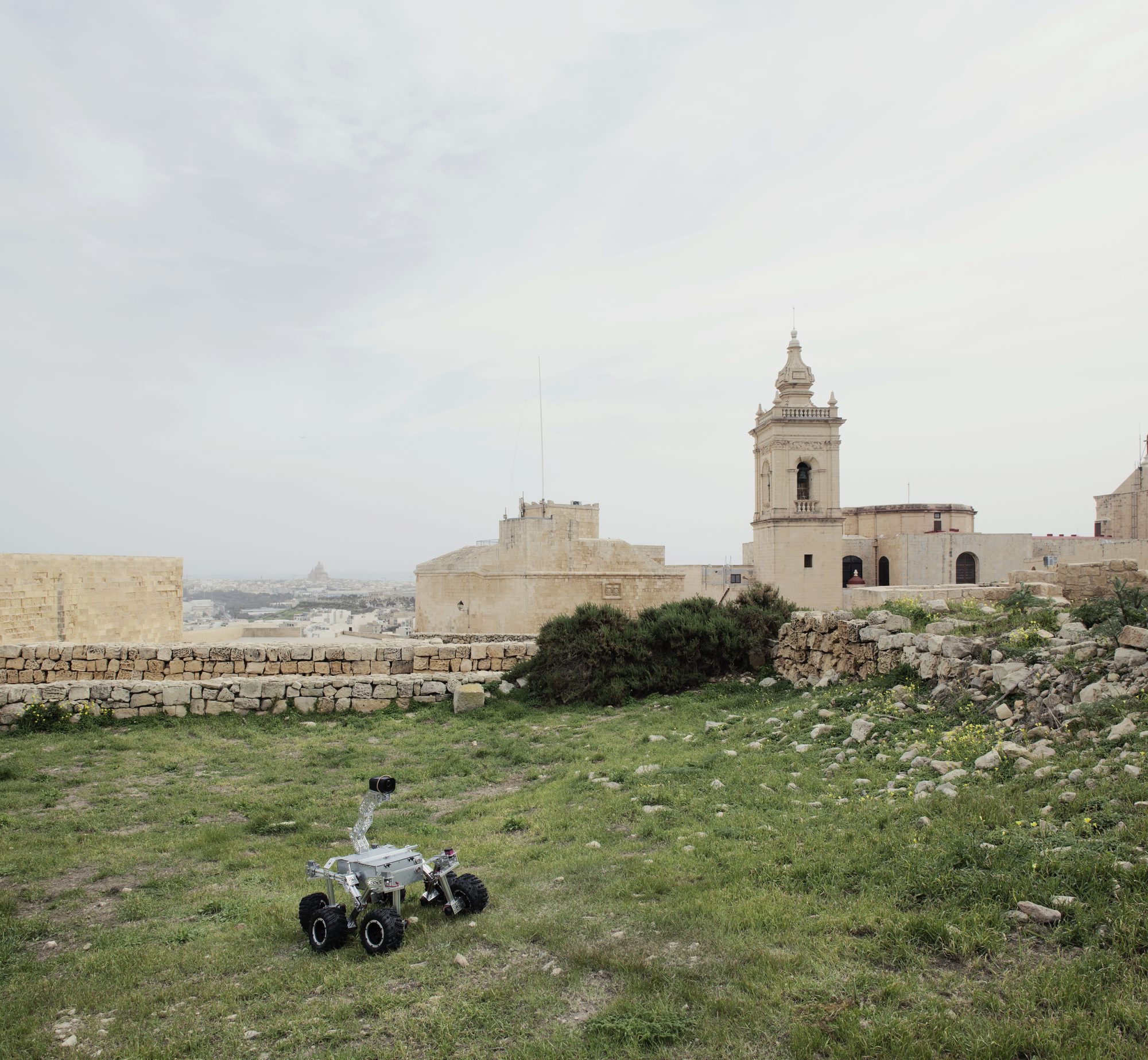
Embassy adapts NASA JPL's Open Source Rover as a six-wheel public instrument. Its open construction keeps locomotion, sensing and transmission materially distinct. The assembly exposes machine behaviour as a sequence of commands, responses and external conditions. Built on NASA JPL's Open Source Rover hardware reference. NASA JPL GitHub ↗ NASA JPL CAD model ↗
Short cycles of movement, pause and relay form the work's public score. Ground resistance, bodily proximity and signal availability alter each cycle. Remote governance acquires a visible duration and a limited radius: motors execute movement, sensors register the site, radio carries observation, and human supervision determines when the sequence continues.

From Reference Chassis to Diplomatic Body
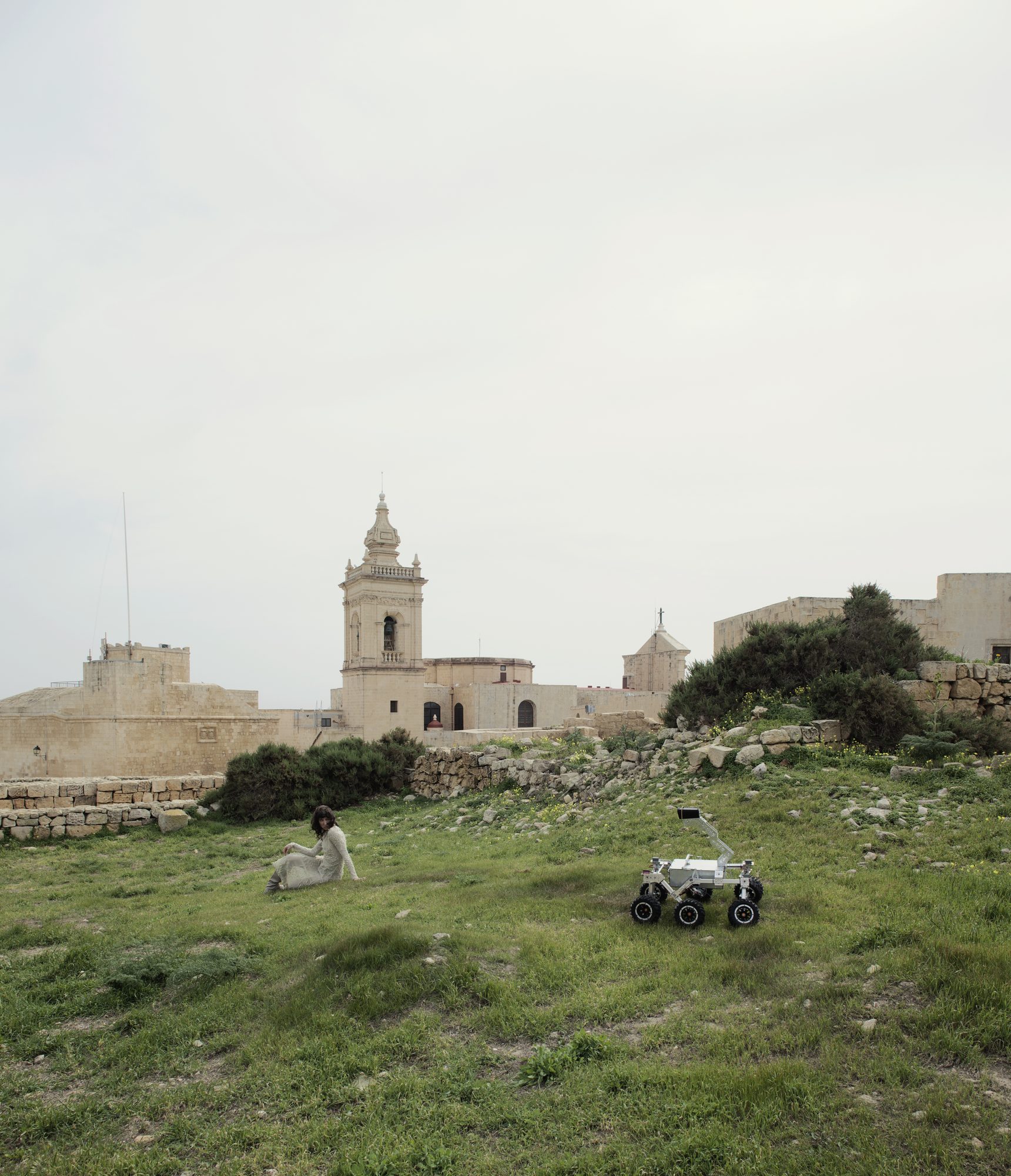
NASA JPL's open-source reference supplies a legible chassis, six modular wheel assemblies and electronics that remain accessible for maintenance. The exhibition assembly assigns a civic function to those parts. Within the Citadel, fortified architecture, an assembled public and the changing reach of the communications link shape the rover's path.
Cables, sensors, wheel motors and radio equipment remain inspectable throughout this translation. Their separation makes the chain of action accountable: a wheel receives torque, a camera frames the field, a connection carries the frame, and an operator reads the result. The diplomatic body emerges from these dependencies and from the temporary jurisdiction produced around its movement.

Movement, Signal and the Radius of Access
Embassy joins displacement across terrain to transmission across distance. Six independently driven wheel modules carry the chassis through short movements and pauses. CCTV, Wi-Fi and speakers extend those movements into observation, remote command and public relay.
Every command passes through material conditions: wheel contact, available battery power, signal range, proximity and on-site supervision. These conditions define the radius within which the platform can act and the public can interpret it. Access appears as an operating state produced between machine, network, institution and public.
A Mobile Embassy at the Citadel
Embassy, 2024 formed part of Malta Biennale's white sea olive groves exhibition at the Citadel, Gozo. Sofia Baldi Pighi directed the main exhibition; Emma Mattei and Elisa Carollo served as curators.
The work belongs to the Republic of Suez Canal, a stateless artistic framework that uses the canal and its imperial history to examine trade routes, citizenship and coexistence beyond national representation. Embassy gives this framework a mobile diplomatic body: it can cross a site, transmit a signal and organise an encounter around its temporary position.
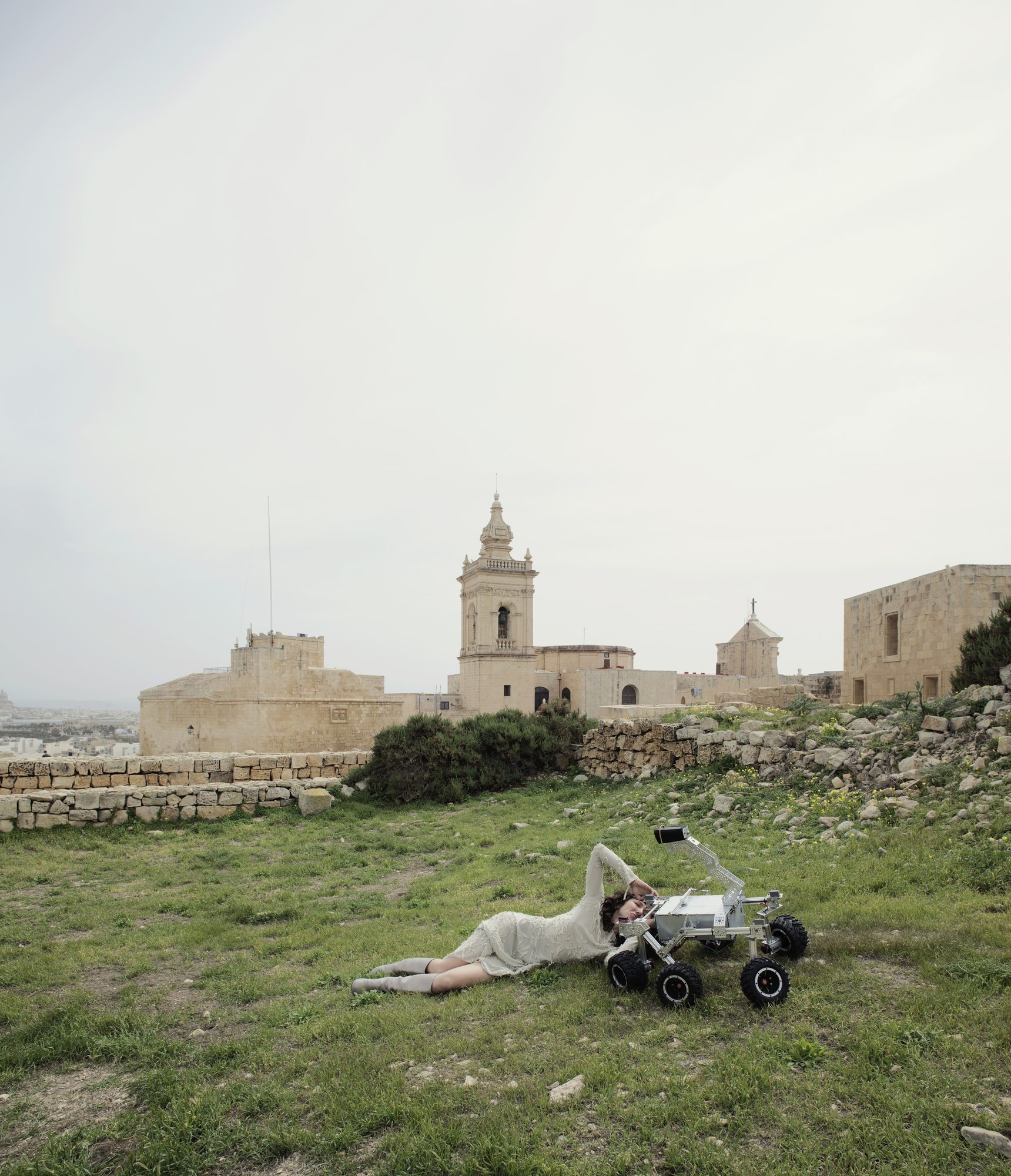
At the Citadel, the rover moved through the terrain as an installation and a performed encounter. Its mobility displaced the embassy from a fixed building to a negotiated radius around the machine. Visitors, operators, signal and ground conditions continually redrew that radius. Autonomy functioned as a public claim under test, measured through interruptions, proximity and the visible work of supervision.
The assembly combines anodised aluminium, stainless steel, rubber wheels and motors, microcontrollers, printed circuits, solar input, battery power, CCTV, Wi-Fi and speakers. The open chassis keeps these subsystems visible and maintainable. Their arrangement also exposes the work's political sequence: energy enables motion, motion positions the sensor, transmission moves observation across distance, and a human decision returns to the vehicle as command.
Inside a fortified site, technologies associated with exploration, surveillance and remote command entered the Biennale's examination of the Mediterranean as a political body. The Citadel supplied more than a setting. Its surfaces, walls and controlled passages materially conditioned circulation and made the machine's limited field of action perceptible.
The project continues a trajectory first made public through Marco Polo Returns through Suez at the Swamp Pavilion of the 16th Venice Architecture Biennale. In Gozo, the Republic took the form of a working object. Its authority depended on components open to inspection, changing conditions and a public able to witness both operation and limit.
Hijacking the Rover
The earliest Embassy texts describe the rover through a deliberate act of counter-use. The reference machine belongs to the lineage of planetary exploration, remote sensing and the technical imagination of territory at a distance. Suez keeps that lineage visible instead of pretending the chassis is politically neutral. The project asks what changes when a device designed to extend the reach of an aerospace institution is reassigned to a stateless and mobile embassy. The same motors, cameras, radios and autonomous functions remain, but the purpose attached to them is altered. Exploration is no longer treated as a step toward possession.
This shift is central to the work. Embassy does not reject surveillance technology from outside; it enters the system and changes its use. In the project texts, the rover becomes a pirate vehicle that turns surveillance toward counter-surveillance, evasion and the production of temporary zones of coexistence. The gesture is practical as well as symbolic. Open hardware can be modified, repaired and extended by a community outside the institution that originally designed it. The political proposition depends on that technical possibility. A machine becomes available for another form of organisation because its architecture can be accessed, understood and changed.
Shelter, Relay and Shared Capacity
Embassy was conceived as more than a moving camera. Early plans describe a vehicle carrying capacities associated with remote survival: shelter, water, food, signalling and rescue, alongside communications equipment able to connect a remote site with an outside network. These elements matter because they shift the meaning of autonomy. The rover is not autonomous simply because it can move without a person standing beside it. Its autonomy is measured by whether it can sustain a temporary relation between people, resources and communication in a place where ordinary infrastructure is weak or absent.
The same logic extends to the Republic's idea of a parallel communication network. A mobile embassy can relay information, help people find one another and support a temporary network of knowledge around the site. This gives the work a practical horizon without converting it into a humanitarian device or claiming capabilities it has not deployed. The prototype asks what a small, mobile and open technical stack could make possible if its purpose were not extraction but shared access. It is a question that later returns in SeaCommons and Liability: infrastructure becomes political when it determines who can observe, communicate, act or remain unseen.
The Machine Is Never Alone
Embassy stages autonomy as something negotiated with terrain, battery, radio range, supervision and public proximity. At the Citadel in Gozo the rover moved inside a bounded historical site where irregular ground and architectural enclosure shaped what it could do. The machine could be watched from above, becoming an object that appeared contained while still remaining unpredictable. That condition matters. The work never needs to claim unrestricted autonomous navigation. Its force comes from showing a machine whose possible actions are larger than the public can immediately read, but whose real operation is still constrained by material and institutional limits.
This makes Embassy an important precursor for the newer Suez research on agents. The useful distinction is between capability, authority and action. A rover may be capable of moving or transmitting, but that does not mean every movement or transmission is authorised. The same question can later be asked of software agents. Embassy gives the problem a physical body: motors can turn, a radio can connect, a camera can see, yet the meaning of those capacities depends on the jurisdiction and protocol built around them. Autonomy appears not as independence from the world, but as a changing relation to it.
Diplomacy Without a Fixed Territory
The Republic gives Embassy an institutional role without pretending that the institution is complete. A conventional embassy represents a sovereign territory from a fixed address. Embassy does the opposite. It moves, depends on temporary access and can establish only a provisional radius around its current position. This makes diplomacy a spatial and technical event rather than a building. The vehicle carries the fiction of representation with it, but the fiction is continuously tested by terrain, connection and the people who encounter it.
This mobility also connects Embassy to the Republic's longer interest in islands, maritime routes and other spaces where jurisdiction overlaps with logistical necessity. The rover does not solve that tension. It stages it at human scale. A camera can observe beyond the body of the vehicle, a radio can extend a relation beyond the site and a wheel can cross a boundary that architecture would otherwise hold still. The work asks whether a diplomatic instrument can be defined by the relations it makes possible rather than by the territory it claims to represent. In that sense, mobility is not decoration but the condition through which representation itself is tested.
Can an exploration vehicle become an instrument of coexistence?
The following reproduces the complete substantive project text prepared for Embassy in 2024, with spelling and punctuation lightly normalised for publication.
Embassy is a custom version of the OSR project by NASA's Jet Propulsion Laboratory, a NASA open-source-designed rover built to experiment with some of the technologies and mechanics prototyped on Martian vehicles. This vehicle represents the nomadic and dynamic embassy of the Suez Canal Republic, which contains tools for sheltering, sharing, resistance and rescue, and collects information from the environment and people to keep track of it.
Embassy subverts the diplomatic and institutional role of the embassy by becoming a moving and almost untraceable GPS point. Its structure and the architecture it contains leave no traces; they adapt to the landscape without altering it. It is a pirate vehicle as it hijacks the surveillance technologies it is equipped with to make itself autonomous and stealth: it uses the system to exclude and evade it. In doing so, Embassy reaches out to the citizen by finding remote frontiers, making tools available to survive there and sewing the first social networks.
The vehicle has a brain, a Raspberry Pi, that controls six motors, is powered by solar energy and is also connected to satellite networks. In this way it can be controlled from anywhere in the world, making it an autonomous vehicle which, with future implementations, can be completely managed by artificial intelligence.
The instruments contained in the rover derive from contexts such as mountaineering or the high seas. The devices include lightweight structures that can be easily assembled and stowed in a small space and weight in the rover. Items include shelter through isothermal tents, cultivation through seeds, food and drinking water through purification and canned food, and rescue equipment such as smoke bombs and lights.
In addition to these objects, the rover has embedded technologies that allow connection to the internet and communication with the outside, making it a platform for both reception and communication.
Among its systems, the Republic of Suez Canal proposed to use its network and capacity to build a parallel communication network of the Biennale, in order to expand the horizons and bring more audiences to the project. In full pirate spirit, this form of communication would help the other artists involved and the local community to interact, meet and possibly collaborate, activating a network of knowledge useful to the production of the works.
The rover, as a concept and prototype, can be considered the ultimate colonial vehicle, which the great aerospace powers, public and private, build to explore, analyse and de facto colonise the potential and resources of an unattainable or extra-planetary territory. The space race shaped a new potential common battleground, activating new war fronts where rovers are the sentinels through which academic-political soft power manifests itself.
NASA's open-source project can also move in this direction, asking a community of professionals and amateurs to develop further potential, open new technological paths and functions in order to accumulate more in-depth information. But in the case of the Suez Canal Republic, its intended use is hijacked and the embedded surveillance technologies become a pirate counter-espionage tool for the surveillance system itself.
Embassy does not serve to explore in order to appropriate territory, but rather exploits surveillance technologies to stall, hide and imagine frontiers of coexistence beyond institutional and sovereign space.
Embassy at maltabiennale.art was conceived as a dynamic device displayed outdoors and self-monitored. The Old Ruins of the Citadel in Gozo were identified as the location: the highest point of the city and the place where the rover could inhabit irregular and off-road terrain.
The environment offered distance from the public while allowing the work to be observed from the Scenic Walk, transforming the space into an arena and the rover into a mysterious device that searches it, apparently blocked but unpredictable because of the technologies at its disposal. On a performative level, the ruins and enclosures build a path where the rover can move and use its tools to construct nomadic architecture while respecting the historical, artistic and natural heritage of the location.
The Suez Canal Republic is the project of an ideal stateless nation that manifests itself as a think tank to deconstruct the geopolitics of trade routes and the capillary way in which they design new strategies of consumerism and models of citizenship. The project takes as its symbol the Suez Canal, born from Europe's imperialist ambition to unite East and West and transformed into the vital bottleneck on which global maritime trade depends.
Starting from local contexts, the Republic sketches global trajectories by imagining new models of community citizenship and trans-governmental coexistence. It emerges from the histories of decolonisation and the proliferation of stateless political forms, grouping together individuals, bodies and entities united simply by the economic and financial system that governs them.
Following the model of pirate codes throughout history, the Republic is a loose cannon, capable of adapting itself to each territory and provoking different situations each time.
Technical Specs and Operational Notes
Full technical documentation for Embassy is available in the public docs hub.